Ouray

Results

The following priorities were established as a result of four Planning Advisory Team meetings. These meetings reviewed and analyzed multiple points of data to establish and discuss Ouray School District needs and desires moving into the future.  The process included analyzing the needs of the District. Multiple ideas were reviewed by the group and proposed solutions were established.

These potential projects were developed through a collaborative process with RTA, School District leadership, and the Planning Advisory Team.  Each potential project below responds to deficiencies and needs that were identified through the research and investigation phase of the master planning process.


Whiteboard titled ‘Key Takeaways’ with notes: ‘New gym is too much right now’; ‘Need better academic spaces first’; ‘Some level of renovation to the gym building is needed in the near term’; and ‘Focus more on academics and multi‑purpose space.’

Survey

When the 17‑member Planning Advisory Team was asked to rank program spaces from most to least urgent, they identified these areas as the highest priorities. These priorities became the foundation for the Phase One project.

Infographic showing how the Planning Advisory Team ranked program spaces from most urgent to least urgent to improve. The highest‑priority spaces identified were Wood Shop/CTE, Band Room, Kitchen, Art Room, and Cafeteria. Lower‑priority spaces were the Weight Room, Gymnasium, Vocal Room, and Locker Rooms. A note states that the team included 17 participants.

Identified Priorities

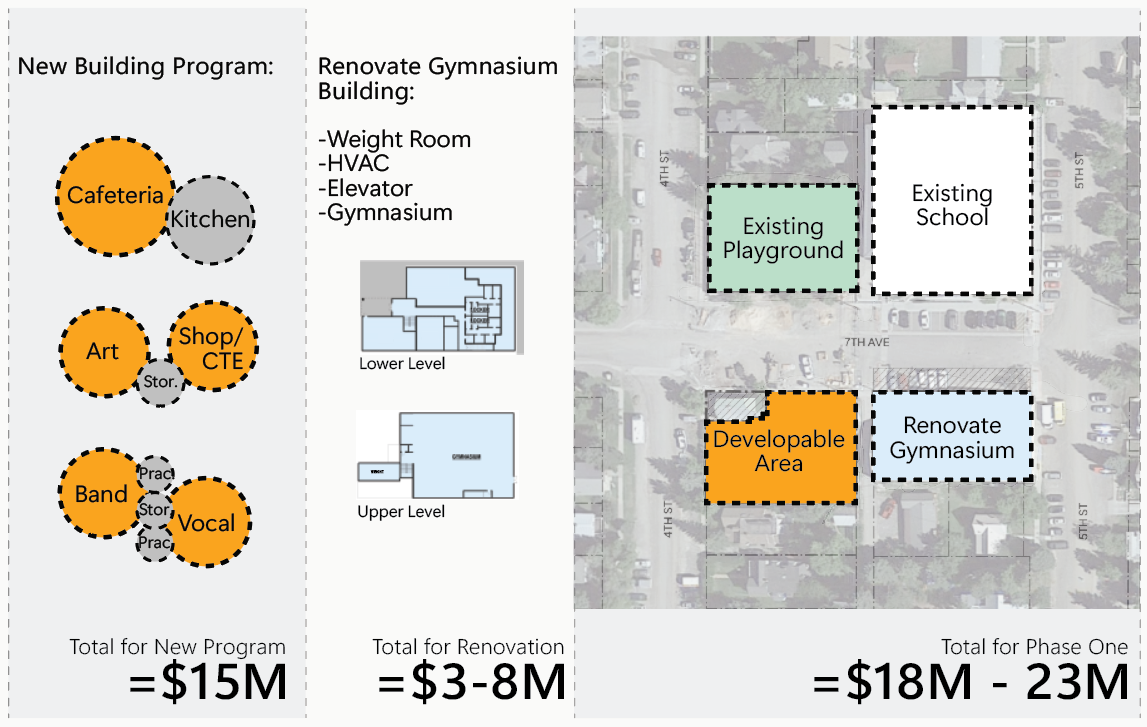
Infographic summarizing proposed project components and estimated costs. The new building program includes a cafeteria, kitchen, art room, shop/CTE spaces, band room, and vocal room, with an estimated cost of $15 million. The gymnasium building renovation would address the weight room, HVAC, elevator, and gymnasium, with an estimated cost of $3–8 million. A site diagram shows the existing school and existing playground, and highlights the developable area and the gymnasium building to be renovated. The total cost for Phase One is estimated at $18–23 million

Phase One Project

Renovates the existing gymnasium to provide expanded wood shop, art, and weight spaces, while also constructing a new building featuring a main‑level cafeteria and kitchen, upper‑level band and vocal rooms.
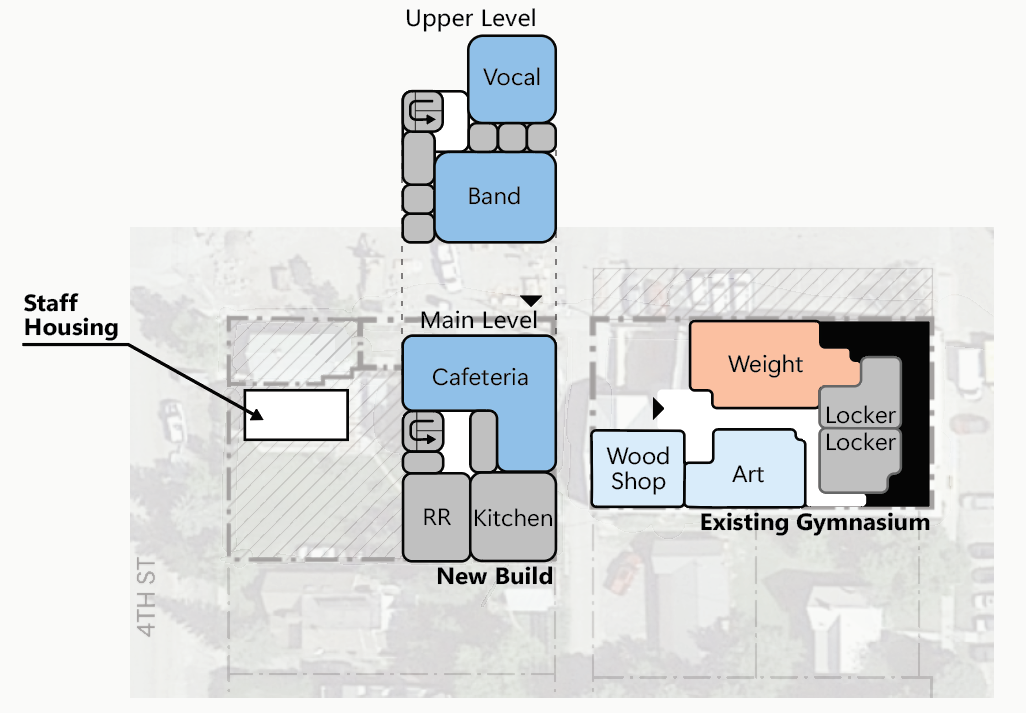
Site and floor plan diagram showing the layout of proposed phase one project. Spaces across the existing gymnasium building and a new build. On the main level of the new build are the cafeteria, restrooms, and kitchen. Adjacent to the gymnasium on the main level are the wood shop, art room, weight room, and two locker rooms. A note identifies staff housing on the west side of the site. The upper level includes the vocal room and band room positioned above the main‑level spaces.

Future Phase Project

Benefits to a Campus Concept

Safety

When schools acquire and close public streets running through or adjacent to their property, it eliminates vehicle cut-through traffic, reducing collision risk and improving pedestrian safety.

Cohesion

Taking over streets allows schools to unify fragmented parcels into a single campus. This creates a more attractive, organized environment and supports long-term master planning. Districts often use this approach to connect academic buildings with athletic fields and playgrounds, giving students a true “campus feel.”

Additional Space

Redeveloped streets can serve as designated drop-off loops and expanded parking areas, easing congestion and improving traffic flow during peak times. They can also be repurposed for outdoor learning spaces, playgrounds, or future building expansions—an especially valuable solution for landlocked schools with limited growth options.

Campus Options

Option 1: Maintain 7th Avenue as open to traffic and keep street parking. The existing playground, existing school, and existing gymnasium remain in their current locations, with Phase One and future phase areas shown along 7th Avenue. Option 2: Close 7th Avenue to create a drop‑off zone and relocate the playground to the southeast side of the site, next to the existing gymnasium. Phase One and future phase areas are shown along the closed roadway. Option 3: Close 7th Avenue and demolish the old gym. A new playground is placed on the east side of the site, with a pedestrian plaza and a defined drop‑off loop added on the southwest corner. Option 4: Close 7th Avenue, demolish the old gym, relocate the playground to the northwest corner, and add a new parking lot and pedestrian plaza on the south side. Future phase areas remain on the southeast portion of the site.
RTA logo
◆  Architecture
■  Master Planning
●  Interior Design
19 South Tejon Street, Suite 300
Colorado Springs, CO 80903
(719) 471-7566